Old Spanish Trail Association Old Spanish Trail Passport Stamp
Powered by Google
|Spanish Traces Journal|Become a Member|Events Calendar 
Home
2010 Conference
What’s New
About OSTA
FAQs
Trail History
Exploring the Trail
Passport Stamp Locations
Maps
Trail Partners
Retail Store
Old Spanish Trail Books
Trail Management Plan
NPS Website
National Historic Trails
Kid's Corner
Contact OSTA
 
Old Spanish Trail Monument Marker at Grand Junction, CO

Protecting, Interpreting and Promoting the
Old Spanish National Historic Trail

mule Explore the most arduous and famous pack mule route in U.S. history, crossing the beautiful but dangerous terrain of the American Southwest.

mule Revel in the lives of travelers such as Kit Carson, Antonio Armijo, Chief        Walkara, John C. Fremont and William Workman, and how they survived the        Trail’s daunting rivers, canyons, deserts and mountains.

mule Consider how the cultural and political intrigue of the Trail’s heyday        continues to challenge and instruct us.

mule Let OSTA assist with your personal discovery of the spirit and adventure of        the Old Spanish Trail.

Experience the National Historic Trail with our Interactive Travel Adventure Map

Interactive Map Demo

Download Free Copies of the Spanish Traces Journal

Members of the Old Spanish Trail Association enjoy three issues of Spanish Traces each year. Archived samples are available as free downloads. Become a member and start your subscription to Spanish Traces today!

Spanish Traces cover

Background on the Old Spanish National Historic Trail

For traveling Mexican caravans between 1829 and 1848, the Old Spanish National Historic Trail was known as the shortest path to riches between Los Angeles and Santa Fe. It was a trail of commercial opportunity and western adventure as well as slave trading, horse thieving and raids. The Old Spanish Trail route was established along a loose network of Indian footpaths that crossed the wide expanse of the Colorado Plateau and the Mojave Desert. With time, this newly established trade corridor attracted frontiersmen and U.S. military expeditions.

For a lucky few, the Old Spanish Trail represented fortune. Quality woolen goods produced in New Mexico were traded for a surplus supply of horses and mules raised on California’s ranchos. These valued stock animals commanded premium prices in New Mexico and the western frontier of the United States. Traders and their mule caravans typically began their annual journey from New Mexico in late fall to take advantage of low water river crossings and cooler temperatures across the hot Mojave desert.

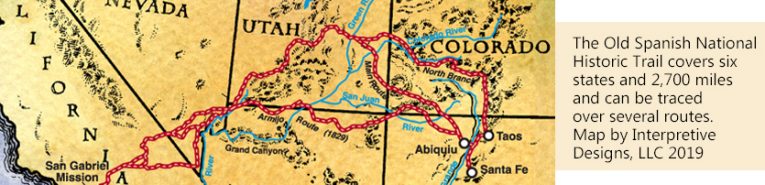
Old Spanish Trail Map

The map above illustrates the variant routes that developed as merchants developed their trade with the Rocky Mountain and Mojave Desert peoples, and the rancheros of coastal California. In 2002, the Old Spanish Trail received designation as a National Historic Trail and today it is widely known as the longest, most arduous and crookedest pack mule route in America. All who took the trail—frontiersmen and young boys with a winter to spare, a handful of hardy families moving West, military expeditions, Indian guides and conscripts—shared the adventure of a lifetime in the Southwest’s rugged back country.

The 2,700 miles of trail which linked Santa Fe with Los Angeles pushed mule caravans to the limit. In the first week on the trail alone, the mules scrambled, swam, or dragged their handlers through more than a dozen river crossings. By the time the pack trains reached Los Angeles, they had crossed dune fields in California, Nevada, Utah, Arizona, New Mexico, and Colorado, found their way around the Grand Canyon, skirted the continent’s harshest deserts at Death Valley, and slaked their thirst at Stinking Springs, Salt Creek, Alkali Canyon, Bitter Spring, and the Inconsistent River.

Forged By Mexican and American Traders

The trail takes its name from the old Spanish colonies in northern New Mexico and southern California which were linked by this rugged route. The Spanish outpost of Santa Fe, NM was founded in the early 1600's ten years before the Plymouth Colony was established by the Mayflower pilgrims. The presidio of Monterey was founded in 1770 and the San Gabriel Mission in 1771. But it was not until 1829 that a suitable land passage between these colonies in the interior of New Mexico and the California coast became established and regularly used. Today, only a few remnant traces of the trail can be seen where hundreds of fast trotting mules and their tired muleteers once traversed the high country of New Mexico and Colorado on their way to California’s fertile trading fields.

welcome photo

OSTA Members receive
3 issues of Spanish Traces per year and other membership benefits.

Join Today


Workshop Training
Now Available
Become an Old Spanish Trail Steward

workshop training


Next OSTA Conference

June 2-5, 2011

(More info)


Support OSTA projects by becoming a Credit Card partner. Personalized credit cards have No Annual Fee and provide a new opportunity to make history come alive

Credit Card

Support OSTA with every purchase. A $50 donation is made to OSTA when the card is first used. In addition, there are ongoing contributions for each card transaction. No annual fee and no additional cost to you.

Click here to become a card partner and request your personalized No Annual Fee Old Spanish National Historic Trail Visa Card


© Old Spanish Trail Association
Powered by Inciteful Studios